
How to Future-Proof Your Mind and Build Resilience for Life’s Unknowns
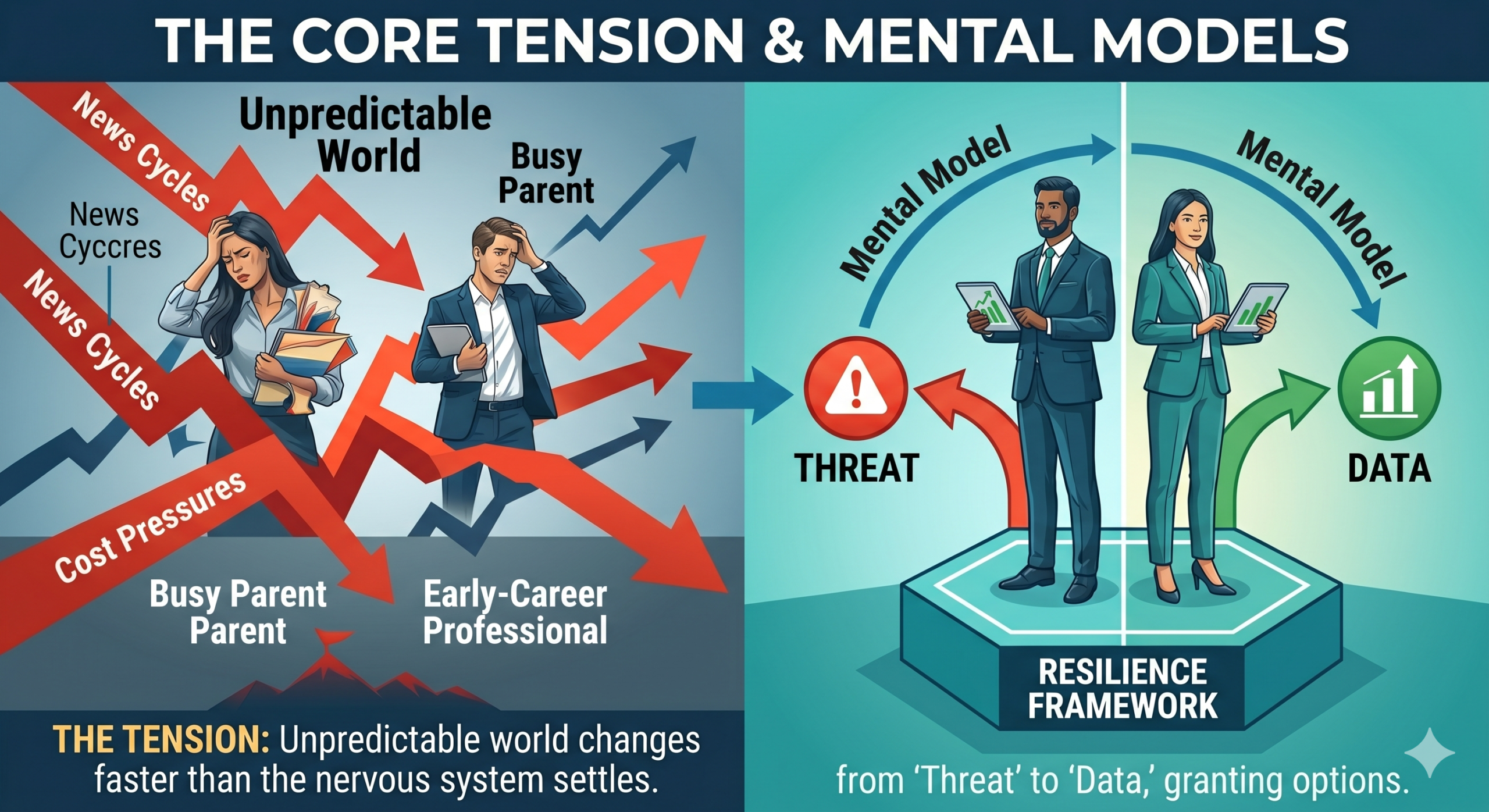
Busy parents juggling work and wellness, early‑career professionals riding shifting job demands, and caregivers holding families together all face the same core tension: an unpredictable world can change faster than the nervous system can settle. News cycles, cost pressures, health curveballs, and social stress can make everyday decisions feel heavier than they should. Future‑proofing the mind isn’t about predicting what’s next; it’s about strengthening mental resilience and psychological adaptability so uncertainty stops hijacking focus, energy, and mood. With steadier inner footing, general readers can meet unpredictable world challenges with clarity.

Understanding Resilience and Mental Models
At its core, resilience is the capacity to recover quickly when life swerves. Resilience frameworks help you build three skills together: openness to change, a curious mindset, and emotional agility so feelings inform choices instead of driving them.
This works because uncertainty usually hits your mental models first. Mental models are taken-for-granted ways of operating that shape what you notice and how you react. When those models shift from “threat” to “data,” you get options.

Picture a last-minute schedule change. Openness helps you adjust the plan, curiosity helps you ask what matters most today, and emotional agility helps you feel the stress without snapping at anyone. With the concept clear, small daily habits can make these skills automatic.
Daily Resilience Rituals for an Uncertain World
Habits work because they train your nervous system and attention before life gets loud. With a few repeatable reps, you build a steadier baseline, spot change faster, and choose responses you can stand behind.
Two-Minute Breath Reset
- What it is: Do five slow breaths, extending your exhale a little.
- How often: Daily, plus anytime tension spikes.
- Why it helps: It downshifts stress so your next choice is clearer.
One New Question
- What it is: Keep a daily goal to ask a new question.
- How often: Daily.
- Why it helps: Curiosity turns uncertainty into information you can use.
Name It, Then Choose
- What it is: Label the feeling in one word, then pick one next step.
- How often: Whenever you feel reactive.
- Why it helps: It separates emotion from action without suppressing either.
Tiny Optimism Log
- What it is: Write one “still good” moment and one “could work” idea.
- How often: 3 times weekly.
- Why it helps: Rising optimism has decreased by 19% risk of early death.

Common Questions About Resilience and Uncertainty
Q: How can I cultivate openness to change when facing constant uncertainty?
A: Start by separating what you can influence from what you cannot, then act on one controllable item today. Reframe change as a series of small experiments: try, review, adjust. A simple cue like “What is this teaching me?” helps your mind stay flexible instead of defensive.
Q: What are effective ways to manage fear and replace it with curiosity in unpredictable situations?
A: Fear often signals uncertainty, not danger, so name the fear and locate it in your body for 10 seconds. Then ask one question: “What information would help me decide?” Take one low risk step to gather that data, even if it is just a conversation.
Q: Which mindfulness and emotional agility practices help strengthen mental resilience daily?
A: Use a quick check-in: notice your breath, label the emotion, and choose a value-based action. Add a brief body scan while walking or washing dishes to train attention without extra time. Consistency matters more than duration.
Q: How do supportive relationships contribute to maintaining optimism balanced with realism?
A: Good support helps you co-regulate stress, so your nervous system settles faster after setbacks. Ask trusted people for two things: validation of what is hard, and a practical perspective on what is possible. Clear boundaries keep support energizing rather than draining.
Q: What strategies can someone use when they feel stuck and overwhelmed, and want to pursue a new direction or skill set to regain control?
A: First, pick skills that lower stress and increase options, like communication, problem-solving, and self-management. Choose a micro-routine: 20 minutes, three times weekly, with one measurable output each session. Some people set about to earn an IT degree online as one structured way to expand their education and build more career options.
Your Resilience Routine Quick Checklist

This checklist turns a big idea into a doable daily practice. Use it when life feels uncertain to steady your body, clear your thinking, and choose one helpful next step.
✔ Identify one controllable action for today
✔ Reframe one change as a small experiment
✔ Name the fear and feel it for 10 seconds
✔ Ask one curiosity question that guides your next move
✔ Do a 60-second breath and emotion label check-in
✔ Choose one value-based action to take within 15 minutes
✔ Reach out to one supportive person with a clear ask
✔ Schedule three 20-minute skill sessions with a measurable output
Check off one item now, and let momentum do the rest.
Steady Optimism That Builds Lifelong Mental Resilience
Life stays uncertain, and the hard part is holding hope without drifting into denial or dread. The path forward is the same mindset you’ve been practicing: a reflective resilience summary, balanced optimism, and continued personal growth, steady enough to meet facts, flexible enough to adapt. Over time, this creates sustained mental strength: decisions get clearer, stress recovers faster, and setbacks feel more workable. Resilience grows when realism and hope train together, one day at a time. Choose one item from the checklist and practice it once in the next 24 hours, then note what shifted. That small repetition is how a lifelong resilience commitment supports health, performance, and connection for whatever comes next.
Thank You so much to Connor Hoffman for a brilliant Article.
A Note From Ben:
My goal is to help you build a life of health and freedom. This blog is supported by two resources I personally use and trust to achieve that mission:
- My ASEA Business: Supporting my family’s wellness from the inside out.
- “Success in 10 Steps”: The framework I use for building a successful business from home.
You can learn more about ASEA here and “Success in 10 Steps” here.
Discover more from Coach Freedom and Friends
Subscribe to get the latest posts sent to your email.
